
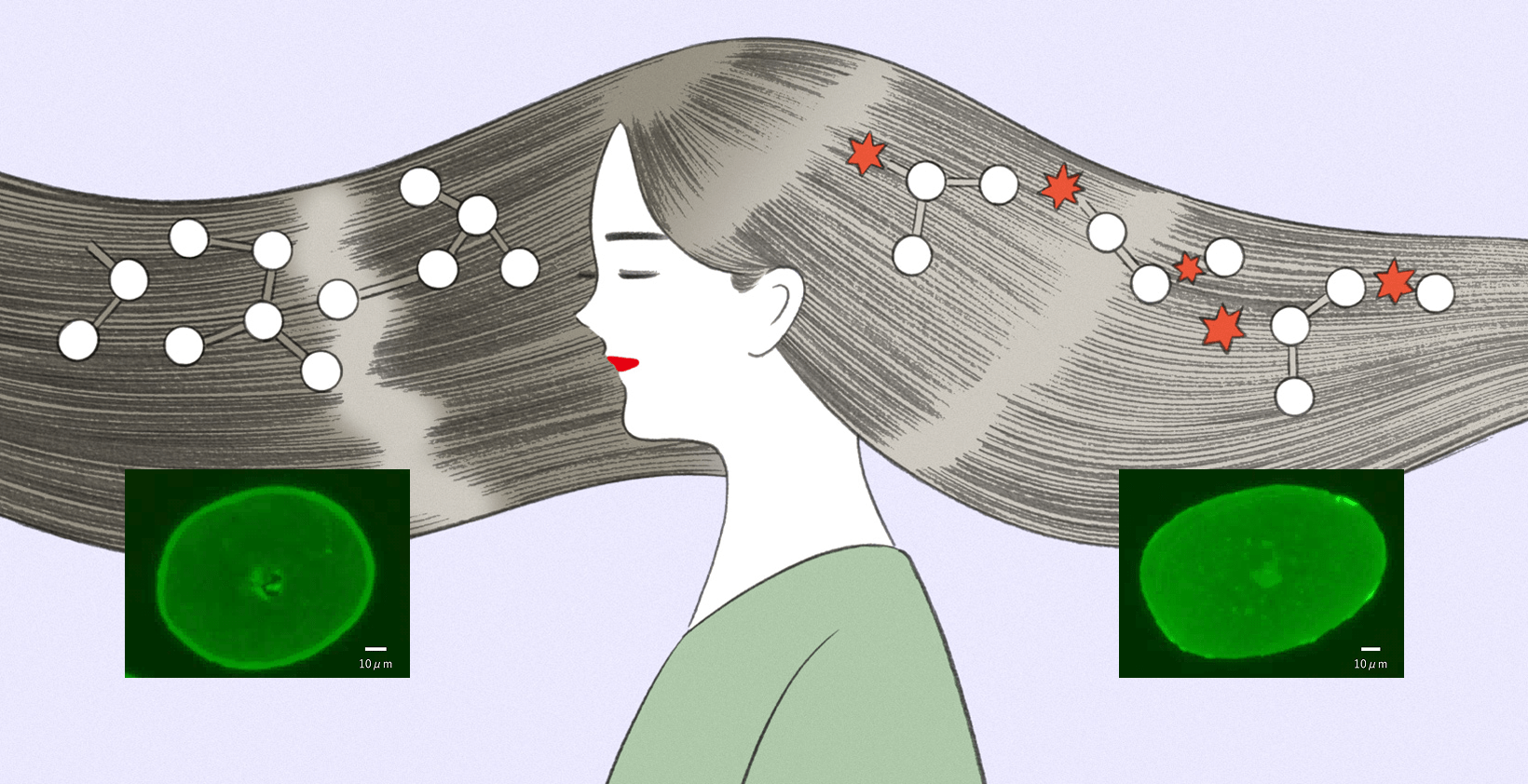
*Image for illustrative purposes only. Reproduction and reuse permitted with source attribution.
New Discovery: Damage Continues to Progress Within the Hair Even After Hair Coloring
Delivering the Right Care as Hair Changes Over Time—For Long-Lasting Beauty
Hair Damage Continues Even After Coloring
Behind the beautiful results of hair coloring lies an enduring challenge: hair damage.
“I want to enjoy hair coloring, but I don’t want to damage my hair.” This challenge inspired Kao researchers to look deeper into what happens to hair after coloring.
What they focused on was the time after coloring. Taking a deeper look at the structural changes occurring inside the hair, they uncovered a new damage mechanism: chemical changes continue within the hair not only during the coloring process but also after coloring.
What then came to light was that the damage mechanism inside the hair differs between the coloring process and the period afterward. By understanding how this damage shifts over time and delivering the right care, the team found it was possible to reduce signs of damage, such as dryness and color fading, that set in seven days after coloring and beyond.
Let’s take a closer look at the “Hair Link Protection Technology” developed based on these insights.
Not Just During the Coloring Process: Internal Damage Caused by Hair Color
Why Does This Happen? Beautiful Hair Just Won’t Last After Coloring
The appeal of hair coloring lies in its ability to transform your look and expand your styling possibilities.
Hair color can deliver beautiful results, yet the damage it does to the hair is a real concern. Right after coloring, the hair looks and feels better, making it difficult to notice signs of damage. But after seven days or more, many of us start to notice dryness and a rough texture when we run our fingers through our hair, and it begins to bother us. This may sound familiar.
Hair color triggers a chemical reaction inside the hair, breaking down the hair's natural pigment and setting a beautiful new color in place. At this stage, however, some of the damage-causing agents (radicals) generated during the coloring process can contribute to hair damage.
In addition, after hair coloring, the cuticle becomes more prone to opening and lifting, leaving the hair more vulnerable to surface damage caused by friction during everyday activities such as shampooing and sleeping.
Traditionally, the focus has been on two types of hair damage: primarily internal damage that occurs during the coloring process, and surface damage caused by friction afterward.
Although hair care products such as hair masks and hair oils have been used to care for damage after hair coloring, the signs of damage we notice in our hair rarely appear immediately after coloring. More often, they become noticeable about a week later—or even beyond.
“Could hair damage continue to progress even after coloring—before we ever notice the signs!?”
This question led us to identify the “transition phase”: the seven days after hair coloring, when damage continues to progress.
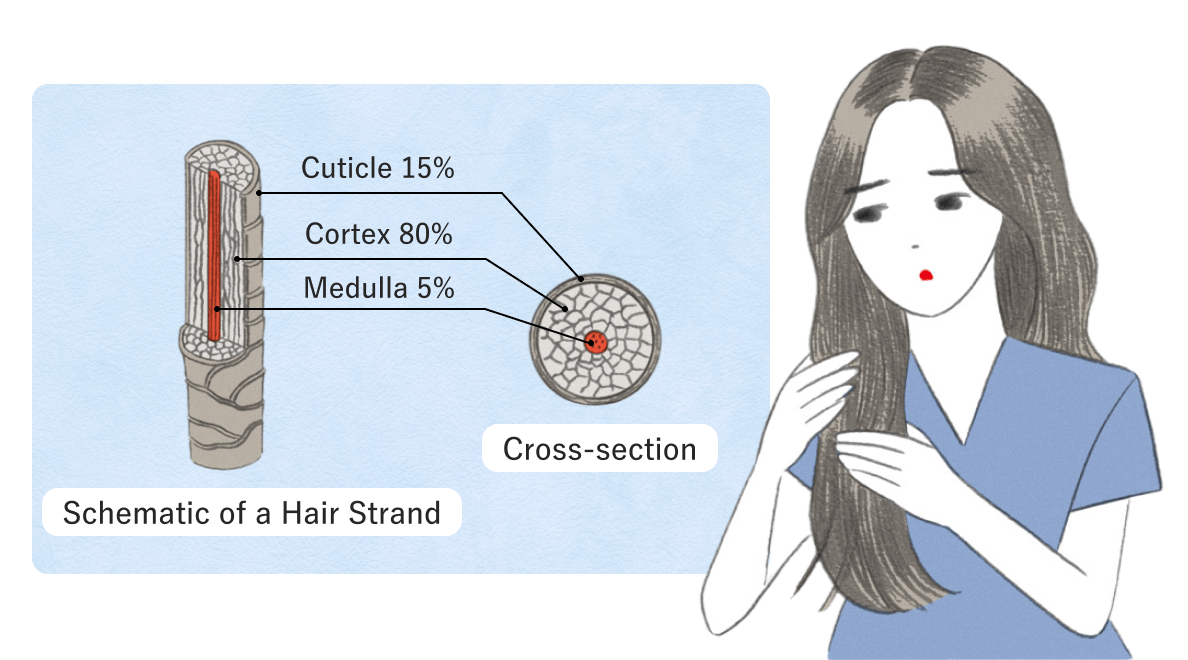
*Image for illustrative purposes only. Reproduction and reuse permitted with source attribution.
COLUMN 01
About 100 Microns Across! How Do You Examine the Inside of Hair This Fine?
- The Story Behind the Research: Hair Research Begins with Seeing “What Can’t Be Seen”
-
The changes taking place inside the hair are extremely small and cannot be seen with the naked eye. That is precisely why, in the lab, making the invisible “visible” is a goal that calls for all kinds of ingenuity.
For example, in experiments that examine hair colored with oxidative dye under a microscope, you need to look at a cross-section of the hair. To do that, a single hair must first be sliced into sections just microns thick.
This is not something a machine can do on its own. Every cut demands precision—the angle of the blade, the pressure applied, and the researcher’s trained expertise all matter. A single misstep can cause the sample to crumble, making analysis impossible.
The challenge becomes even greater when the changes inside the hair are too small to see clearly.
Such small changes often cannot be detected using ordinary observation methods. So we turned to a fluorescent reagent with a special property: it lights up only where a reaction has occurred. What was invisible at first now glows only in the spots where a reaction took place, finally making even small changes inside the hair visible.A strand of hair is only about 100 microns in diameter. Understanding what happens inside the hair requires exquisitely delicate techniques—and helped uncover the hidden changes that continue after coloring.
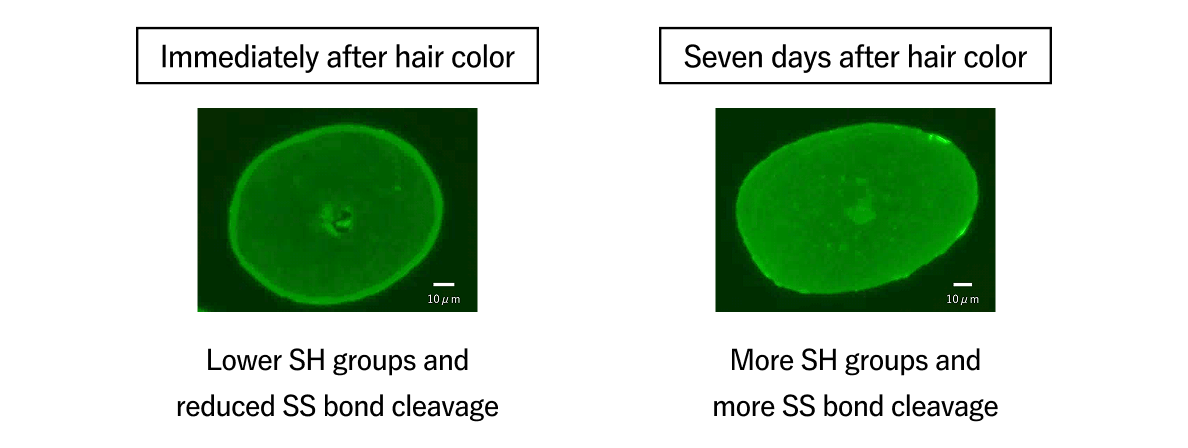
*Reproduction and reuse permitted with source attribution.
The findings of this research have been presented at the following academic conferences:
Tamura, T., Kawakami, R., & Nakatani, A. (2022). A Novel Mechanism for Hair Frizz Caused on the Surface Layer of the Hair.
The 89th SCCJ Research Symposium
Tamura, T. (2025). Elucidation of the Mechanism Behind UV-Induced Hair Waviness and the Development of a Sunscreen Applicable to Hair. Invited Lecture, the 157th MGK Scientific Conference
The First Seven Days: Understanding Damage During the “Transition Phase”
What Happens Inside the Hair During the First Seven Days After Coloring
So what is actually happening inside the hair after coloring?
What we focused on were the bonds within the hair’s proteins, which act like a skeleton supporting its structure. When this skeleton is strong and stable, the hair stays supple, resilient and healthy. When it breaks down, the hair becomes prone to distortion.
The damage that arises during the coloring process has long been understood to result from structural changes in this skeletal part of the hair. And in the first seven days after coloring—the period we call the “transition phase”—we found something more. During these seven days, these skeletal bonds continue to break down. This is the damage we uncovered.
We also learned that the internal damage occurring in the seven days after coloring is driven by a different mechanism from the one involved during the coloring process.
The state of the hair’s skeleton also changes after its bonds break down. During the seven-day transition phase after coloring, protein bonds within the hair may break and re-form in different locations. We found that this misalignment can become fixed as hair waviness, making hair harder to manage and style.
*Reproduction and reuse permitted with source attribution.
The findings of this research have been presented at the following academic conferences:Yoshioka, H., et al. (2026). New approach to maintain hair beautiful after coloring: Time-dependent changes in hair structure and underlying mechanisms. 14th World Congress for Hair Research.
Does It Depend on Your Natural Hair Color!? Hair Damage Caused by Hair Coloring
Naturally very dark hair is rich in a pigment called melanin. To achieve a bright, beautiful shade with hair color, the pigment already in the hair has to be lifted, so going from dark hair to a lighter color makes some going from dark hair to a lighter color makes some level of damage unavoidable.
The key to understanding the damage of the seven days after coloring also lay in that same melanin. Our research showed that melanin granules may play a role in generating these “damage-causing agents” and in the breakdown of the hair’s skeletal structure.
COLUMN 02
- The Story Behind the Research: Why We Had to Look Closely at the Seven-Day “Transition Phase” —Discovering a New Kind of Damage
-
Hideaki Yoshioka
Research Scientist, Hair Beauty Products Research, Kao CorporationHair-color damage happens mainly during the application. For a long time, we have thought so. We researchers, too, built our work on that premise, and yet somewhere along the way, something about it never quite sat right with us.
When we conducted consumer surveys, a good number of people told us they noticed changes in their hair only some time after coloring. I could relate to that myself. I also didn't notice obvious signs of damage right after coloring. However, I had a subtle feeling that something about my hair wasn't quite right for about seven days after coloring. That is what led me to think that explaining hair-color damage as something that happens only during the application might still be missing part of the picture.
The damage long understood to come from hair color was a process in which a violent reaction between hydrogen peroxide and alkali causes structural changes the proteins inside the hair. As these proteins are oxidized, cysteic acid forms. That was the common understanding.
In this latest research, however, we saw that even after the hair color had been rinsed out, bond cleavage was still occurring across the seven days after coloring. This came as an enormous surprise even to us, and at first we could not believe the results. It took repeated experiments, again and again, before we were sure.
This research was made possible by the research assets Kao has cultivated over many years: its understanding of the melanin abundant in very dark hair and of the chemical reactions that take place inside the hair strand, together with analytical methods sensitive enough to capture even the smallest changes. By bringing these together and looking closely, the quiet changes that continue inside the hair even after coloring gradually came into view.
Our decision to focus on “the seven-day transition phase” was no mere coincidence. It was the result of staying close to the very timeline along which people first begin to notice a change in their hair. Years of patiently accumulated research, and a sensitivity to that faint sense that something was not quite right: where the two came together, the path to this technology opened up.
Other TOPIC
If you would like to learn more about H-Linx TECH and how it helps keep colored hair looking and feeling beautiful for longer, please visit the Lifestyle & Beauty section.
An Approach to Inner Hair Protection After Coloring
Protecting Hair from Damage Before It Is Ever Felt
Traditionally, damage caused by hair coloring has been treated after the signs of damage become noticeable. But if the mechanisms and causes of that damage can be identified, it becomes possible to protect against them before they appear as visible damage to the hair. It was this idea that led Kao to develop a new technology that protects the protein bonds inside the hair, helping to reduce damage before it occurs.
By adding ingredients that neutralize the damage damage-causing agents (radicals) that continue to form during the seven days after coloring, it has become possible to reduce damage and help prevent it.
In other words, this is a hair protection technology that differs from conventional aftercare.
*Reproduction and reuse permitted with source attribution.
Other TOPIC
If you would like to learn more about H-Linx TECH and how the discovery of this damage inspired a new approach to protecting color-treated hair, please visit the Lifestyle & Beauty section.
Early Care for Long-Lasting Hair Color and Hair Feel
A Different Coloring Experience Starts Before Damage Appears
Test results showed that incorporating this technology after coloring improved manageability over time while reducing frizz and dryness.
In addition, early care—acting before damage appears—helps color last longer and improves the feel of the hair. Stabilizing the hair’s internal structure also helps prevent deterioration over time.
With this technology, even those who have been hesitant to try hair coloring due to concerns about damage should feel more comfortable giving it a try.
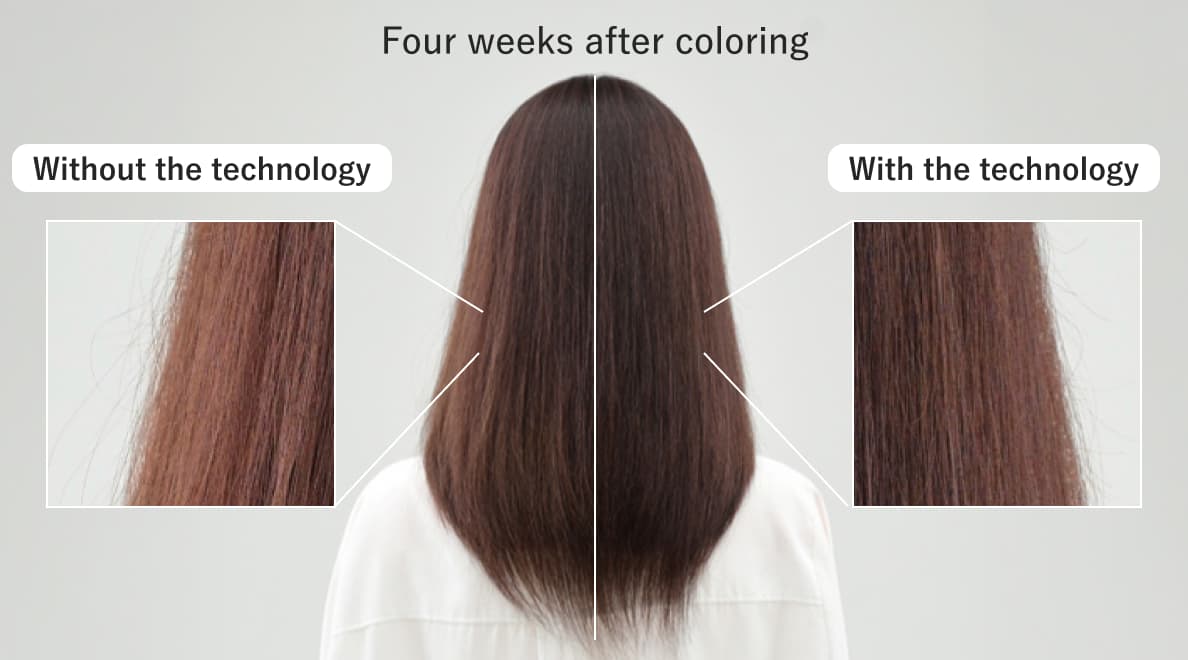
*Photograph showing results obtained using a wig. Reproduction and reuse permitted with source attribution.
Other TOPIC
If you would like to learn more about H-Linx TECH and how it helps keep colored hair looking and feeling beautiful for longer, please visit our Lifestyle & Beauty section: “H-Linx TECH: The First Seven Days After Coloring. An Early Care Approach for Long-Lasting Hair Color and Hair Feel”